
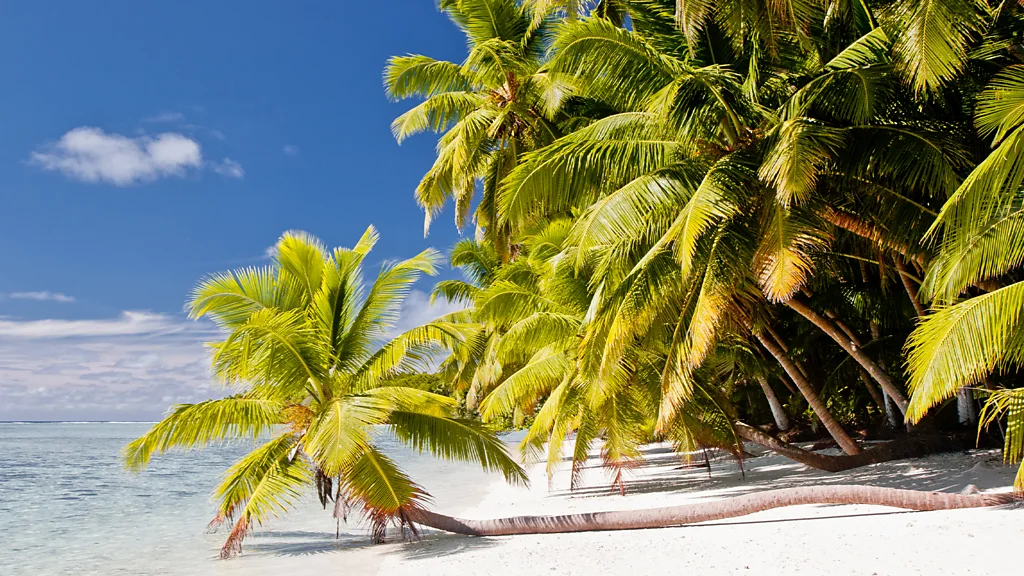
Remote and off-limits to tourists, Chagos is a paradisiacal slice of the tropics that’s home to one of the most pristine reef systems on Earth. So why are they controversial?
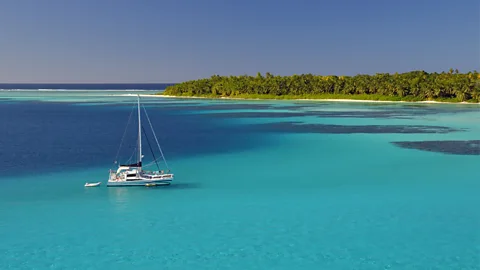
On our third day sailing south from Addu City in the Maldives, thunderhead clouds rose around our boat, reducing visibility to near zero. With full sails, we raced the weather through a reef-strewn pass, weaving between coral mounds until the sea flattened and lush, uninhabited islands slid past on either side. Once we settled on a mooring off the island of Boddam, I realised we had arrived somewhere few people would ever see: the Chagos Archipelago, one of the most remote island groups on Earth.
Chagos is made up of seven atolls and some 60 islands scattered across the Indian Ocean like a handful of shells flung across a vast blue sea. Salomon, its northernmost atoll, lies 286 nautical miles south of the Maldives. Little-known and isolated, it’s a place that demands self-reliance and a tolerance for being profoundly far from anywhere else. Six years into a world circumnavigation, my family and I had sailed halfway around the planet to get here, bringing everything we would need with us – just as the few who venture here must.
Yet despite their apparent insignificance, these palm-studded islands have been thrust into an unlikely international row. In recent weeks, Chagos has become the focus of renewed diplomatic tension between the UK, the United States and Mauritius, reopening questions about sovereignty and the legacy of colonial rule.
The UK has controlled Chagos (officially known as the British Indian Ocean Territory), since 1814. In 1965, the islands were separated from Mauritius when Mauritius was still a British colony and Chagos became formally established as a British overseas territory. The UK purchased the archipelago for £3m, but Mauritius has argued that it was illegally forced to give Chagos away as part of a deal to gain independence.
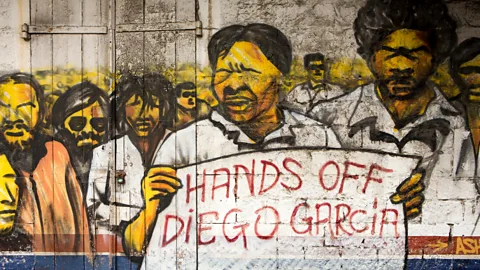
Beginning in 1967, the British government began forcibly removing Chagos’ residents to build a highly secretive joint military base with the United States on Diego Garcia, the archipelago’s largest island. Since gaining independence from the UK in 1968, Mauritius has claimed sovereignty over Chagos, maintaining that it’s an integral part of its territory. Amid growing diplomatic pressure, the UK signed a controversial agreement to hand control of the archipelago to Mauritius in 2025 – a move that US President Donald Trump recently called “an act of great stupidity.”
But while world leaders grapple over Chagos’ future, evidence of its tangled past is everywhere in this mysterious, paradisiacal place.
Pristine and haunted
Chagos is among the most intact reef systems on the planet and has long held a near-mythical reputation among sailors. For decades, self-sufficient voyagers lingered for months, fishing the reef, harvesting coconuts and living slowly. That era ended in the late 1990s, when authorities tightened access. Today, these disputed tropical islands are closed to tourism and the only way for sailors, researchers and authorised visitors to explore the islands is to secure advanced permits, receive a medical evaluation, obtain wreck-removal insurance and then sail to reach this far-flung place, just as we did.
During our four-week stay (the maximum allowed), days fell into a rhythm shaped by the environment. We snorkelled reefs thick with life, spotting dozens of sharks, rays and turtles, and vast schools of wrasse, damselfish and parrotfish. We hiked shaded trails through old plantations, and caught jacks and snappers with ease, logging each one as required. Laundry water came from shallow wells, where rainwater floats above salt. Each day, the skies filled with red-footed boobies, noddies, sooty terns and tropicbirds nesting in astonishing numbers along the shoreline.
Yet fragility was everywhere. The reefs showed patches of bleaching. Each evening, monstrous rats – introduced centuries earlier by European colonists and fat on seabird eggs – emerged from the jungle alongside enormous coconut crabs, pushing us off the beaches and back towards the boat.
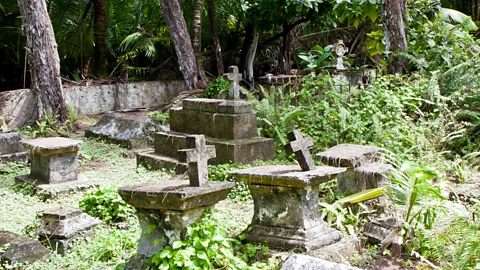
On Boddam – once one of Chagos’ three settled islands – we explored dense jungle threaded with old paths, stumbling across the remains of a church, jail and school built in the 1930s. In the graveyard, nearly every inscription had been erased by time. Someone had lived here long enough to build, bury their dead and imagine a future.
The islands felt both pristine and haunted.
Hoping to understand more, I reached out to Anne-Marie Gendron, a Chagossian in the Seychelles and one of roughly 2,000 people forcibly removed from the archipelago in the late 1960s and early 1970s. She had lived with her parents on Boddam when it was a bustling village of a few hundred residents, and was among the last to leave in 1973.
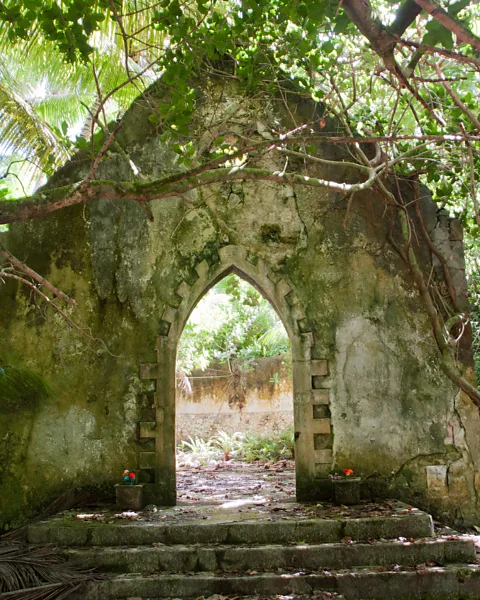
“They told us we had to go to make room for the US military,” she said. “But I was baptised in the church. Generations of my family were buried in the graveyard. We had no other home.”
Some people didn’t even pack, she told me. “They couldn’t understand what was happening.”
Chagos had been settled for centuries, after the Dutch and French brought enslaved Africans and Malagasy people to tend coconut plantations. Over generations, a distinct Creole culture emerged, with its own language, food and music.
Before establishing the US-UK military base on Diego Garcia in 1971, the United States insisted the territory be cleared. British officials, eager to comply, dismissed the islands’ residents as transient labourers. Internal correspondence described them as “a few Tarzans or Man Fridays”, a reference to Robinson Crusoe’s servant.
The entire population was expelled.
Families were put on ships and deposited in Mauritius and the Seychelles, often without compensation, housing or even proof of nationality. Many fell into deep poverty. Some died, Gendron said, of sadness. The UK has since apologised for the nature of their removal.
After the removals, most of the archipelago was abandoned. Villages collapsed into forest. Coconut plantations reverted to jungle. When a vast Marine Protected Area was declared in 2010, Chagos was celebrated as an ecological triumph: a rare example of large-scale rewilding in the tropics.
After years of negotiation, an agreement was announced in 2025 to transfer sovereignty of the islands to Mauritius. The UK – and by extension the United States – would retain operational control of Diego Garcia for 99 years. A £40m trust fund would be created, and the door would open, at least in principle, to some form of resettlement on the outer islands.
For some, it sounded like progress. For others, it felt uncomfortably familiar.
Frankie Bontemps, a Chagossian activist living in the UK, was born in Mauritius after his mother was exiled there. He says discrimination against Chagossians shaped his life and eventually forced him to leave.

